
Visa Ineligibility on Terrorism Grounds (INA 212(a)(3)(B))
When is a foreign national inadmissible on terrorism grounds, and who decides?
INA 212(a)(3)(B) makes inadmissible a foreign national who has engaged in terrorist activity, represents or belongs to defined terrorist organizations, or endorses or espouses terrorist activity, among other grounds. Consular officers apply it to visa applications; the Secretary of State may revoke a visa at any time. Courts give consular decisions very limited review.
- DecidesConsular officers (visa applications); Secretary of State or delegate (revocation); DHS at ports of entry.
- First clockNoneNo statutory clock: revocable at any time
- Precedents5323 taken or upheld2 review or procedure
- Statute8 U.S.C. 1182, 8 U.S.C. 1201
5 precedents, each linked to its primary source; 0 ended with the action revoked, set aside or not sustained. No revoked, set-aside or not-sustained outcome was found in the sources searched (as of October 17, 2026).
Statute
- 8 U.S.C. 1182Inadmissible aliens (subsec. (a)(3)(B), terrorist activities)official text as fetched
- 8 U.S.C. 1201Issuance of visas (subsec. (i), revocation)official text as fetched
Implementing Rule
- 22 CFR 40.6Visas: basis for refusalCFR 2025 annual edition
- 22 CFR 41.122Visas: revocation of visasCFR 2025 annual edition
Timelines
- Any time
No statutory clock: a visa may be revoked at any time.
“the consular officer or the Secretary of State may at any time, in his discretion, revoke such visa or other documentation”
Who Acts
decides, administers, reviews
- Decides
- Consular officers (visa applications); Secretary of State or delegate (revocation); DHS at ports of entry.
- Exempts
- Secretaries of State and Homeland Security under INA 212(d)(3)(B)(i), by notice.
- Reviews
- Consular nonreviewability: courts look only for a facially legitimate and bona fide reason where a citizen's constitutional interest is claimed.
How a Matter Reaches the Agency
2 steps
- Initiation. Applied case by case at the visa interview or on new information; members of the public have no petition mechanism.
- Revocation. Visa revocation is discretionary and effective on notice.
Statute and Rule Text
2 quoted clauses, verbatim
“has, under circumstances indicating an intention to cause death or serious bodily harm, incited terrorist activity”8 U.S.C. 1182
“is authorized to revoke a nonimmigrant visa at any time, in his or her discretion”22 CFR 41.122
Federal Register Cadence
6 notices by year
Precedents
5 precedents
Taken or upheld
Department of State v. private individual Opinion, Supreme Court of the United States
Supreme Court held a citizen has no fundamental liberty interest in a noncitizen spouse's admission.
Source Department of State v. private individual, 602 U.S. 899 (2024). #
Review or procedure
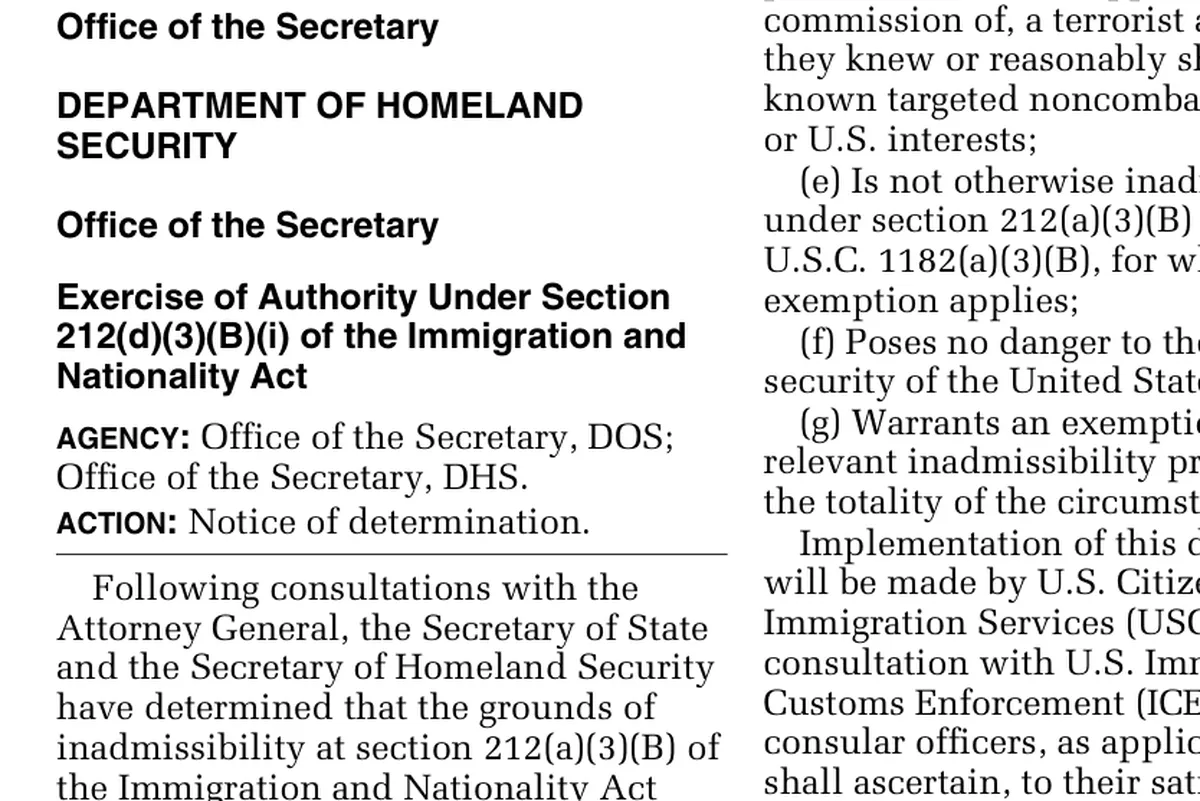
Exercise of Authority Under Section 212(d)(3)(B)(i) of the Immigration and Nationality Act Federal Register
Secretaries exercised the 212(d)(3)(B)(i) exemption authority for a defined class.
Source State Department, “Exercise of Authority Under Section 212(d)(3)(B)(i) of the Immigration and Nationality Act,” Federal Register 87 (June 23, 2022): 37524, doc. 2022-13474. #
Taken or upheld
Kerry v. private individual Opinion, U.S. Supreme Court (U.S. Reports, Library of Congress)
Supreme Court let stand a visa denial that cited only the terrorism ground of INA 212(a)(3)(B).
Source Kerry v. private individual, 576 U.S. 86 (2015). #
Review or procedure
American Academy of Religion v. Napolitano Opinion, Court of Appeals for the Second Circuit
Second Circuit remanded a visa denial resting on material support, for consideration of whether the consular officer confronted the applicant with the allegation and let him rebut it, as the statute's knowledge exception requires.
Source American Academy of Religion v. Napolitano, 573 F.3d 115 (2d Cir. 2009). #
Taken or upheld
Kleindienst v. Mandel Opinion, U.S. Supreme Court (U.S. Reports, Library of Congress)
Supreme Court upheld the denial of a waiver for a foreign speaker on a facially legitimate and bona fide reason.
Source Kleindienst v. Mandel, 408 U.S. 753 (1972). #
Private individual marks a living private person. This site does not print their name; the linked court opinion gives the full caption.